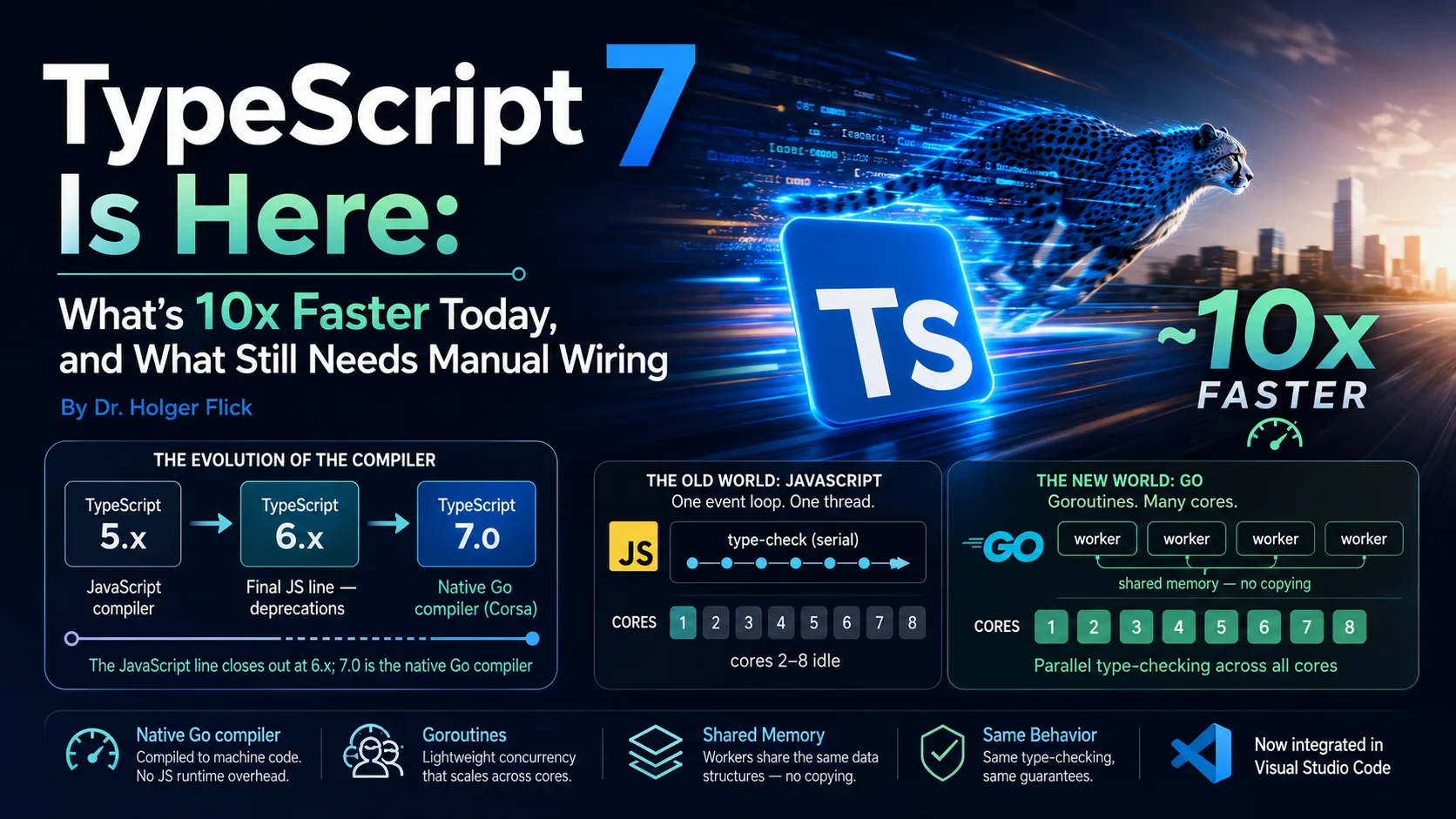
A few weeks ago I wrote about Anders Hejlsberg — the man who gave us Turbo Pascal, Delphi, C#, and then bolted a real type system onto JavaScript with TypeScript — and I noted, almost in passing, that his team had "been rewriting their compiler for raw speed." Well, that rewrite just shipped. TypeScript 7.0 — the compiler reimplemented from scratch in Go — reached general availability on July 8, 2026, and today Visual Studio Code announced it ships integrated.
I'll be honest about my bias up front: I've been waiting for this one. The headline number is roughly a 10x faster type-check, and for anyone who has watched a large project's tsc crawl, that's not a rounding error — it's the difference between a build you tolerate and a build you don't think about.
But "GA" and "VS Code ships it" do not automatically mean your pipeline got 10x faster this morning. There's a gap between the compiler being ready and your framework — Next.js included — actually routing its work through it. This post is the honest state of play: what's genuinely faster today, and what still needs a little manual wiring for a few more days or weeks.
First, the name: it's TypeScript 7, not "the tsgo thing"
Let me clear up the versioning, because it tripped me up too. The native compiler had a working name — tsgo — during its 2025 preview, distributed as the @typescript/native-preview npm package. That name is going away. Internally the effort was called Project Corsa, replacing the old JavaScript-based codebase nicknamed Strada.
The version numbering matters because it tells you the migration story at a glance.
The takeaway from that line: 6.x is the last JavaScript-based TypeScript, kept around to smooth over deprecations, and 7.0 is the clean break to native code. If you've been typing tsgo in preview builds, you can forget it — in the release, the native compiler simply is tsc.
Why the old compiler was slow — and why Go, not JavaScript
Here's the part that fascinated me, and it's worth getting right because it's easy to tell this story wrong. The old tsc wasn't slow because the team wrote bad code. It was slow because of a fundamental mismatch between the workload and the runtime.
JavaScript's execution model is a single-threaded event loop. That design is brilliant for I/O-bound work — web servers juggling thousands of connections, waiting on the network — which is exactly what Node.js was built for. But type-checking a large codebase is the opposite kind of work: it's CPU-bound, a long, dense computation over deeply interconnected data structures. On a single-threaded event loop, that computation monopolizes the one thread it has, and there's no clean way to spread it across the eight or sixteen cores sitting idle in your machine.
Go is a much better fit for this specific job, for reasons that are concrete, not hand-wavy.
Reading that diagram left to right: the same type-checking work that JavaScript had to run serially, Go can fan out across cores. Three properties of Go make that possible:
- Native compilation. Go compiles straight to machine code. There's no JavaScript engine warming up a JIT, no Node.js runtime layer to boot — the compiler is a native binary. That alone removes a startup and interpretation tax on every run.
- Goroutines — cheap, real concurrency. Goroutines are lightweight (a couple of kilobytes each) and the Go runtime schedules them across all your CPU cores. Parsing, binding, and type-checking can genuinely run in parallel instead of taking turns.
- Shared memory. A compiler is a graph of symbols, types, and nodes all pointing at each other. Go's goroutines share the same memory directly, so those workers read the same structures without serializing and copying data between threads — the exact overhead that made parallelizing the JS version impractical.
And there's a pragmatic reason Go won over the alternatives, including Rust: Anders has said plainly that Go was the easiest language to port the existing codebase into. Because Go's structure lined up well with the old code, the team could do a near line-by-line port — same algorithms, same data structures, and therefore the same type-checking behavior. That last point is the quiet hero of this whole project: your types don't start behaving differently just because the compiler underneath got rewritten.
The numbers, and where they came from
I don't want to throw "10x" around without showing the receipts, so here are the figures Microsoft published, measured on real codebases rather than a synthetic benchmark.
| Codebase | Old tsc | Native (Go) | Speedup |
|---|---|---|---|
| VS Code (~1.5M LOC) | ~77.8s | ~7.5s | 10.4x |
| TypeORM (~270K LOC) | ~17.5s | ~1.3s | 13.5x |
| Editor project-load | ~9.6s | ~1.2s | ~8x |
On top of the wall-clock wins, memory usage drops to roughly half of the previous implementation — which matters as much as raw speed on a laptop or in a memory-capped CI runner. The editor numbers are the ones I care about day to day: project load and "go to definition" and rename feeling instant is a different quality of working, not just a faster one.
What's actually faster today
So GA landed on July 8, and today VS Code announced it ships the native TypeScript integrated. Concretely, what changed for you right now:
1. The editor experience, once you're on the native language service
VS Code's TypeScript support — completions, hovers, rename, go-to-definition — runs through the language service. With the native engine driving it, those operations get noticeably snappier, especially on big projects. Visual Studio 2026 Insiders builds have been previewing the same native language service as well.
2. Command-line type-checking and builds
Running tsc --noEmit in CI, or a plain build, goes through the native compiler now. This is where the headline speedups live, and it needs no framework cooperation — it's just the compiler doing its job faster.
What still needs manual wiring (for now)
Here's the honest caveat, and the reason I titled this post the way I did. Frameworks that run their own TypeScript pipeline don't automatically inherit the native compiler the moment it's GA. Bundlers, dev servers, and build tools integrate typescript as a library, drive their own transforms, and sometimes strip types with a separate tool entirely — so "TS7 is out" doesn't flip a switch inside them.
Next.js is the case I hit first. A production Next.js build doesn't lean on tsc to emit your JavaScript at all — it type-checks with TypeScript but transpiles with SWC, its Rust-based compiler. So the native TypeScript engine helps your editor and your tsc type-check step immediately, but wiring it into the framework's own build path is a separate piece of integration work that lands on the framework's schedule, not the compiler's.
The diagram says it cleanly: one arrow is solid and live today, the other is dashed and coming. My read is that it'll take days to a few weeks for the framework side to catch up — but I want to be clear that this is my expectation, not a shipped date on a roadmap I can point you to. Treat it as informed impatience, not a promise.
A fair word on the alternatives
Because this blog tries to show you the whole landscape: the JavaScript ecosystem already has other very fast type-tooling, and TS7 doesn't erase the reasons people reach for it. Tools like esbuild and SWC transpile TypeScript at breathtaking speed by stripping types without checking them — a different job than what tsc does. Node.js itself can now run .ts files directly by erasing types on the fly. Those remain excellent when you want speed of transpilation and are happy to let your editor or a separate CI step handle correctness.
What TS7 changes is the thing only the real compiler can do — full, semantic type-checking — going from slow to fast. So it's not "native TypeScript wins"; it's "the one part of the toolchain that was still slow just caught up with the parts that were already quick." Pick by need: transpile-and-go tools for raw build throughput, the native tsc when you want the type system's full judgment at speed.
Takeaways
TypeScript 7 is the payoff of a genuinely ambitious rewrite, and the honest version of the story is more interesting than the headline.
- It's version 7, and it's native. The Go-based compiler (Project Corsa) is GA as of July 8, 2026; 6.x was the last JavaScript line.
tsgowas just the preview name. - Go fits the workload. Native compilation, goroutines, and shared memory let type-checking run in parallel — something JavaScript's single-threaded event loop couldn't do. A near line-by-line port kept type-checking behavior identical.
- ~10x, on large codebases, for the compiler — not the language. Your runtime is unchanged; your builds and editor get faster, most dramatically where they hurt most. Measure your own repo.
- Editor +
tscare fast today; frameworks follow. VS Code ships it now, but Next.js and friends need to route their own build path through it — expect that over the coming days and weeks, and add a nativetsc --noEmitstep in the meantime.
The language didn't change. The one slow part of the toolchain finally caught up with the fast parts — and that's worth being excited about.
I've been waiting for this since I wrote about Anders and the conviction that runs through everything he builds: fast tools, honest types, the compiler and the editor treated as one product. TypeScript 7 is that conviction, shipped. I can hardly wait to watch the rest of the ecosystem light up behind it.